Maintenance for solar fleets
Predictive maintenance for solar fleets: inverters, trackers and strings
Vantage Systems builds predictive maintenance for solar operators that combines SCADA (supervisory control and data acquisition) and monitoring data with weather to flag failing inverters, struggling tracker motors and underperforming strings before small faults become long outages. Each flag names a likely cause and a location, so planners can send one truck roll that fixes several problems.
Key facts
- What it is
- Models over inverter, tracker, string and weather data that rank equipment by risk of failure or lost energy.
- Integrates with
- SCADA, inverter and tracker monitoring portals, irradiance and weather feeds, and your CMMS (computerized maintenance management system).
What can predictive maintenance catch on a solar site?
Faults that build slowly enough to be seen in the data, across four equipment groups:
- Inverters: rising internal temperatures, cooling fan problems, repeated trips and derating that alarms treat as one-off events.
- Tracker motors and controllers: rows that lag their neighbors, stall at the same angle, miss stow or draw unusual current.
- Strings: output below neighboring strings under the same sun, pointing to a connector, fuse, module or wiring issue.
- Soiling: losses that grow between rains or washes, separated from weather so cleaning is scheduled when it is worth it.
Why combine SCADA, monitoring data and weather?
Because each source alone raises false alarms. Inverter portals report what the inverter thinks, SCADA records site power and meter data, and weather explains most of the variation in between. Lining them up by time and equipment, with on-site pyranometer readings checked against satellite irradiance, lets a model tell lost energy from low sun.
Much of this is data engineering. Tag names differ across sites and vendors, clocks drift and communication gaps leave holes, so the first phase usually builds a clean data layer, the work described under data infrastructure. Every string or tracker row is then judged against its neighbors and against expected output for the measured irradiance and temperature.
How does it change truck roll planning?
It turns a list of alarms into a ranked work plan per site. A technician driving out to a remote site should replace the failing fan, reset the stalled tracker controller and check the weak strings on one visit, and the plan says which parts and tools to bring.
Flags become work orders in your CMMS with the evidence attached, so planners can weigh expected lost energy against the cost of a visit. Findings from the field are recorded against each flag, which is how the models learn your fleet. The solar and renewables industry page covers our wider work for operators.
What we build for solar operators
Fleet data layer
SCADA, inverter, tracker, meter and weather data cleaned, time-aligned and mapped to one equipment list per site.
Expected energy models
Baselines per inverter and per string from irradiance, temperature and history, so underperformance is measured against what the sun allowed.
Equipment health scores
Inverter, tracker and string scores, each with its likely cause and the readings behind it.
Work order and route planning
Flags grouped by site and priority into work orders so each truck roll covers everything worth fixing there.
More for this industry and service
- Predictive maintenance: the full service
- Solar and renewables: everything we build
- Voice agents for solar companies
- Customer relationship management for solar companies
- Predictive maintenance for food and beverage plants
- Predictive maintenance for oil and gas operators
- Predictive maintenance for packaging machine builders and plants
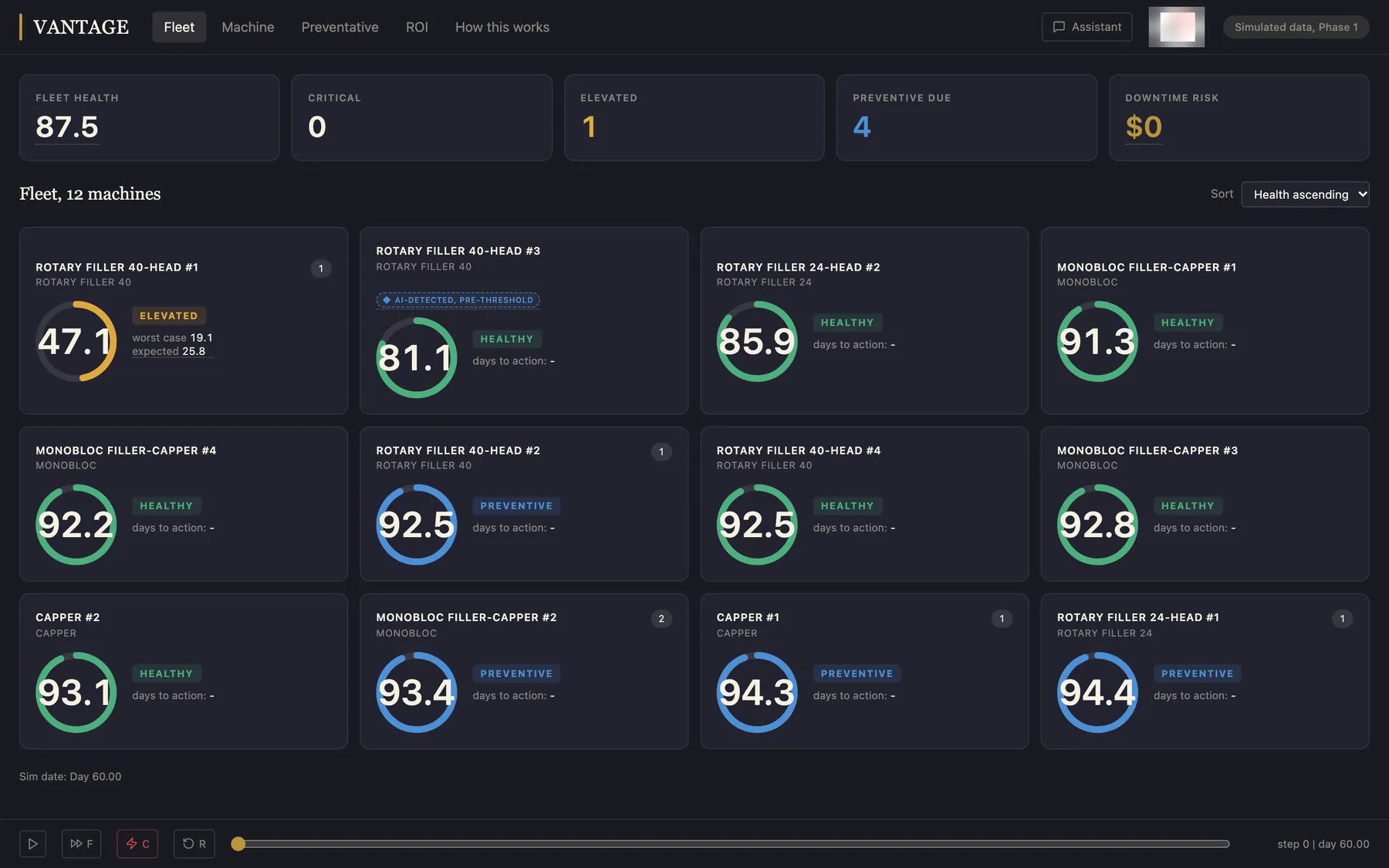
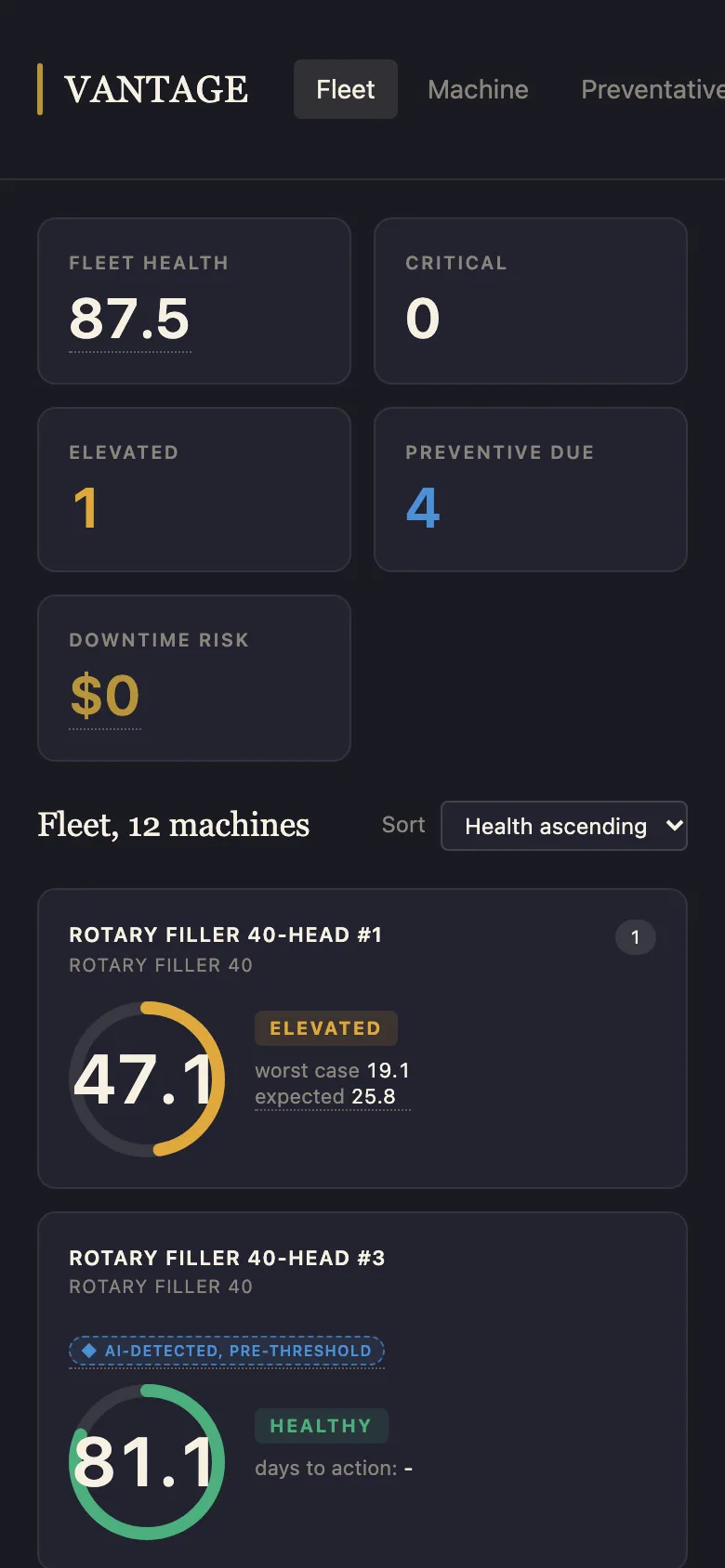
LivePackaging machinery manufacturer, United States
The method, proven in a different industry
Our live predictive maintenance system for a packaging machine builder runs on rotary fillers, not solar arrays, so its sensors and failure modes differ. What carries over is the discipline: models that name a specific part rather than score a whole machine, and testing against faults introduced on purpose before anyone relies on a prediction. On a solar fleet, that means checking models against known historical faults and controlled tests agreed with your site team.
Read the full storyHow an engagement works
Fleet data review
We pull SCADA, inverter, tracker and weather data from a few sites and list what is missing, mislabeled or misaligned.
Pick the failure modes
With your asset managers, we choose the faults that cost the most energy or truck rolls and confirm the data can show them.
Backtest, then shadow
Models are tested against past faults, then run beside your current alarms while technicians check flags in the field.
Roll out across the fleet
Sites join in batches, flags flow into your CMMS, and we keep the models and data feeds running after launch.
Frequently asked questions
Do we need new sensors?
Usually not at first. Most sites already record what the models need through inverters, trackers, meters and weather stations, and we add sensors only where a gap blocks a decision that matters.
Does it work across mixed inverter and tracker brands?
Yes. We map each vendor's tags and alarm codes to one equipment model, so like is compared with like across the fleet.
How is this different from our monitoring platform?
Monitoring tells you something tripped. Predictive maintenance tells you which equipment is drifting toward failure or losing energy, how confident the model is and what to bring on the next visit.
Can it help decide when to wash modules?
Yes. Soiling loss is estimated per site and compared with the cost of a wash, and the answer shifts with season, dust and rainfall.
Does it handle commercial rooftop fleets?
It can, with lighter data. Rooftop systems often report at the inverter only, so models focus on inverter health and output against weather, and owner calls can be handled by a phone agent built for solar companies.
Related
- ServicePredictive maintenanceVantage Systems builds predictive maintenance AI (artificial intelligence) that names the part about to fail and the window to fix it, from sensors, controller data and wear models.
- IndustrySolar and renewablesVoice agents that reach solar leads in minutes, CRMs (customer relationship management) from first call to permission to operate, and fault prediction for inverters and site equipment. Read on.
- Predictive maintenanceFor oil and gas operatorsPredictive maintenance for oil and gas pumps and compressors, built on your historian and SCADA (supervisory control and data acquisition) data, with edge units for remote sites and safety-led installs.
- Voice agentsFor solar companiesAn AI voice agent for solar companies that calls homeowner inquiries back fast, qualifies on roof, bill and ownership, and books the site survey.
- PricingHow we priceFixed scope and a fixed price for each phase, and what drives the cost of a build.
Built for operators with real scale. Most engagements are scoped in the tens of thousands of dollars and up.
Start a conversation.
Tell me what's slowing your operation down. I read every message myself and reply within one business day.