Failure prediction for filling and packaging lines
Predictive maintenance for packaging machines, down to the part that will fail
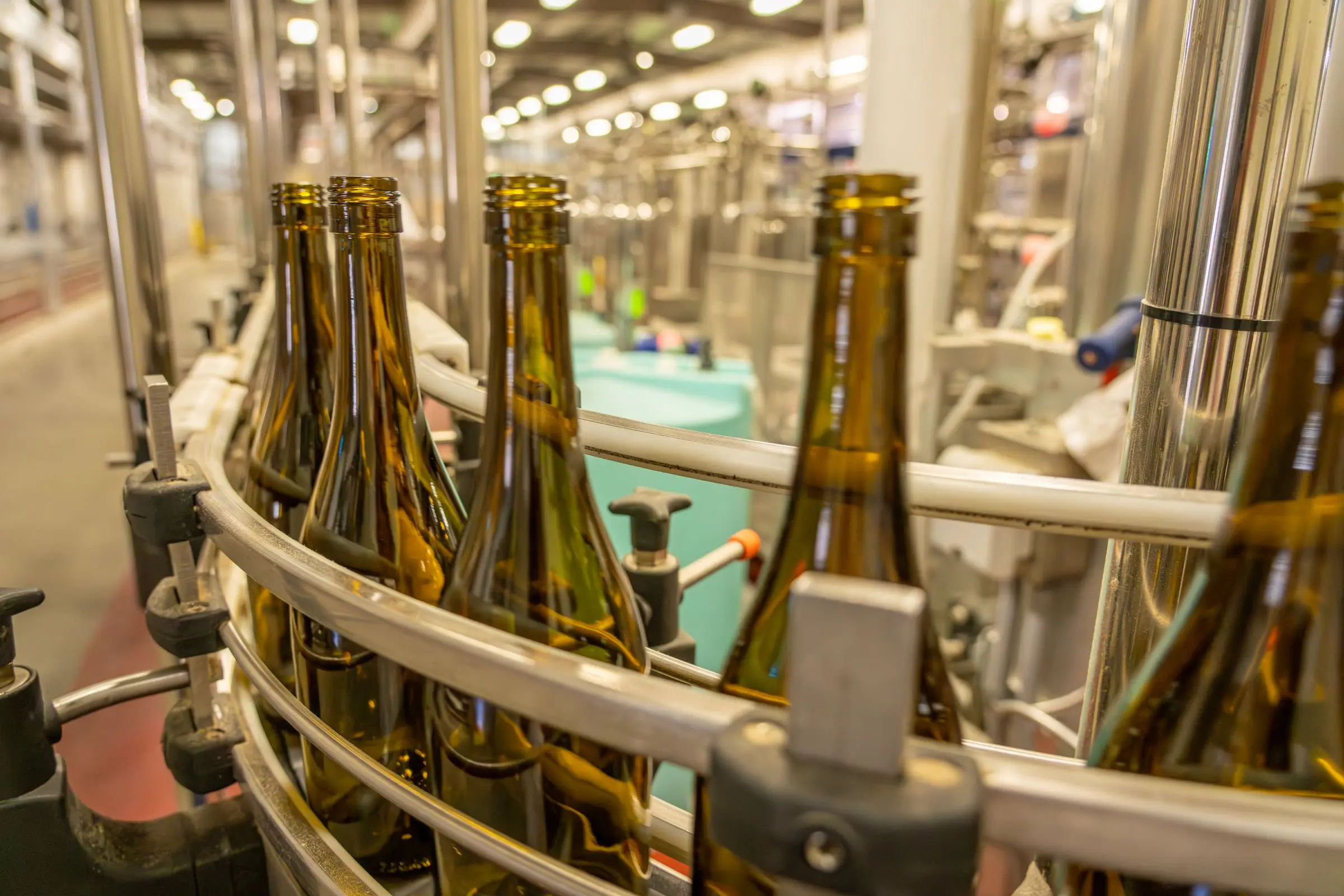
Vantage Systems builds predictive maintenance for packaging machines that tells a maintenance team which part on which filler, capper or labeler is wearing out, early enough to replace it during a planned stop. It is live today for a rotary filler builder, using heat, pressure and temperature sensors plus a camera, with models tested against faults introduced on purpose before anyone relies on them.
Key facts
- What it is
- Part-level wear prediction for filling, capping, labeling and conveying equipment.
- Who it is for
- Packaging machine builders serving an installed base, and plants running high-speed packaging lines.
- Data sources
- Added sensors, cameras, programmable logic controller (PLC) signals and maintenance history.
Which packaging machine parts can be predicted before they fail?
The parts that wear gradually and show it in heat, pressure, temperature, timing or appearance are the ones worth modeling. On a packaging line that covers most of the expensive surprises.
We pick the sensor per failure, not per machine. A probe tells you a lot about a filling valve; a camera says more about a worn star wheel pocket or a fraying label edge.
- Rotary fillers: filling valves, seals, lift cylinders and bowl pressure
- Cappers: chuck wear, clutch slip and torque drift on each head
- Labelers: vacuum drum pressure, glue system temperature and web tension
- Star wheels and timing screws: pocket wear and handoff timing between machines
- Drives and gearboxes across the line: heat and load trends
How do changeovers affect the predictions?
Changeovers move the baseline, so the model has to know which format is running. A new bottle size brings different change parts, fill volumes and speeds, and a signal that is normal for one container can look like wear on another.
We read the active recipe or format from the PLC and compare each machine only against itself running the same product. A change part that was fitted badly at changeover shows up as its own pattern, which helps the crew catch it before it damages anything else.
Should the machine builder or the plant own the system?
Either can, and the economics differ. A plant owns predictions for its own lines; a builder can run them across every machine it has shipped and sell the result as a service contract.
Builders taking that route usually pair it with a customer relationship management (CRM) system for machine builders, so each prediction becomes a parts quote or a scheduled visit. We wrote up that model in predictive maintenance for original equipment manufacturers.
What we build for packaging lines
Sensor and camera kits
Chosen per failure mode, with mounting that survives cleaning and changeovers.
Part-level wear models
One model per failure that matters, each trained on your machines and tested against induced faults.
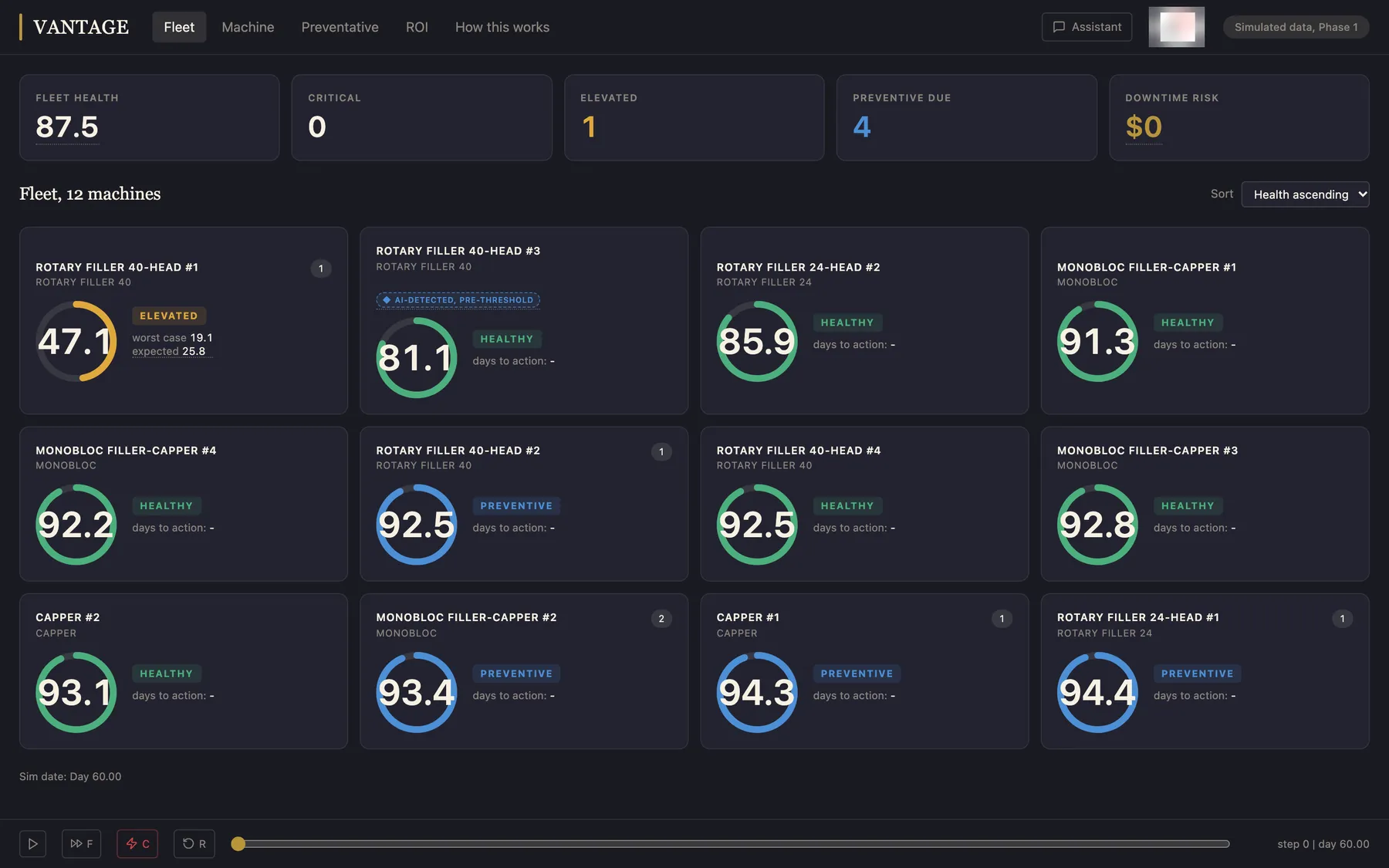
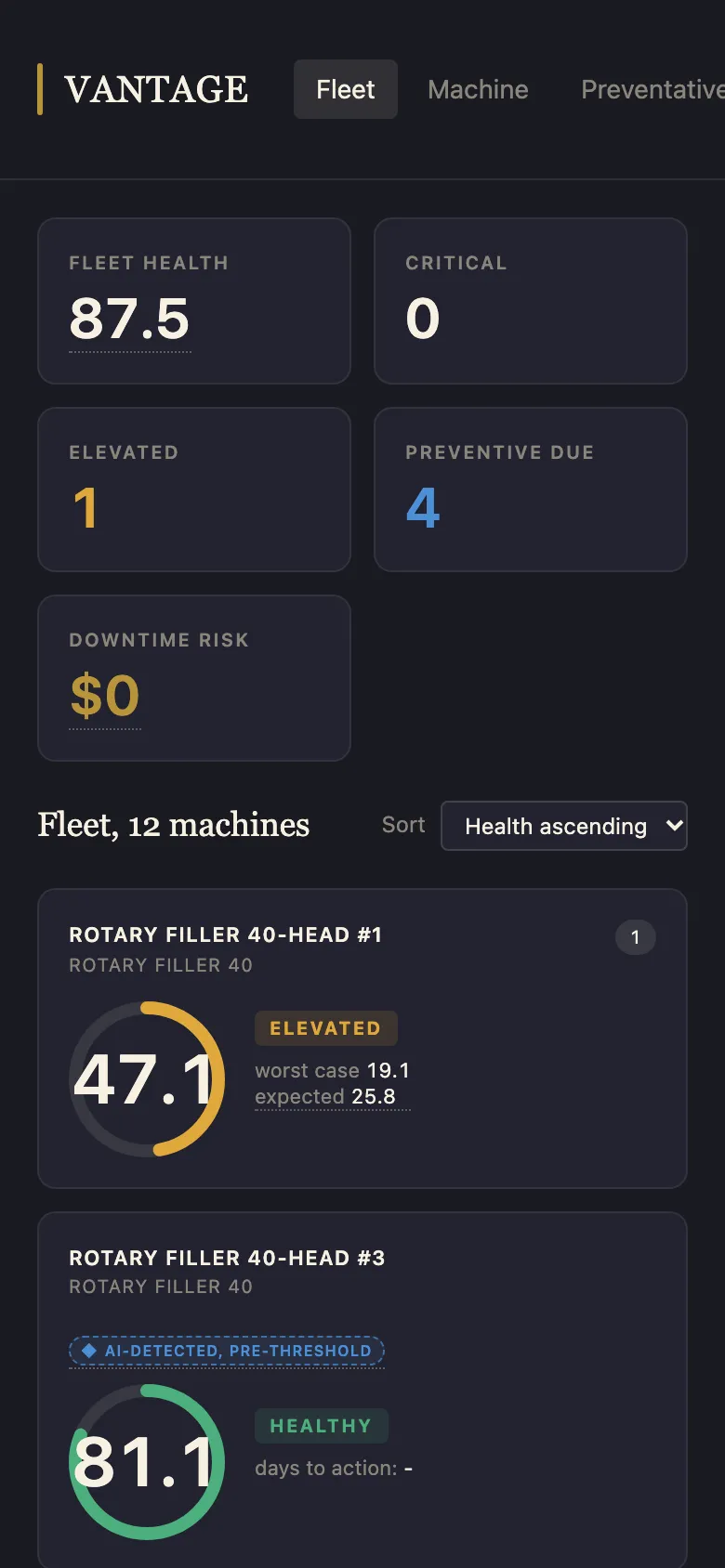
A fleet health view
Every machine with a health score, the part at risk and a suggested window to replace it.
Alerts into your maintenance system
Predictions create work orders in your computerized maintenance management system (CMMS) instead of another inbox.
More for this industry and service
- Predictive maintenance: the full service
- Manufacturing and machine builders: everything we build
- Customer relationship management for machine builders
- Operational dashboards for manufacturers
- Predictive maintenance for food and beverage plants
- Quality inspection for food and beverage plants
- Predictive maintenance for oil and gas operators
- Predictive maintenance for solar operators
LivePackaging machinery manufacturer, United States
Live on a rotary filler fleet
A rotary filler builder has about 250 machines in customer plants, and a repair after a failure can run into six figures. We fitted heat, pressure and temperature sensors plus a camera where visual wear tells more than a probe, then built models that predict wear on specific parts. 12 machines are on the platform today, and the builder can extend it across the fleet. Read the packaging predictive maintenance story.
Read the full storyHow an engagement works
Rank the failures
With your service records and technicians, we list the part failures that cost the most downtime and repair.
Instrument a pilot group
Sensors and cameras go on a few machines first, and each signal is checked for noise and gaps before modeling starts.
Prove the models on purpose
We introduce controlled faults and check each model catches them before anyone acts on its alerts.
Roll out across the fleet
More machines join in waves, and we keep tuning and maintaining the models as formats and parts change.
Frequently asked questions
Does this work on older packaging machines?
Yes. Added sensors and cameras do not depend on the age of the control system, and where a PLC exposes useful signals we read those as well.
How do you know a prediction is real?
We test it. Before alerts go to a crew, we induce known faults on a machine and confirm the model flags them at the right part.
Will sensors survive washdown and changeovers?
They are chosen and mounted for it. Placement is agreed with your maintenance lead so change parts can still be swapped without touching the instrumentation.
Can a machine builder offer this to its customers?
Yes, that is how our live system runs. The builder sees its installed machines in one view and can package predictions into service contracts.
Which machines should join the pilot?
The ones whose part failures cost you the most. A good pilot group mixes machines with a known history of those failures and machines in good condition, so the models learn both patterns.
What does it connect to?
Your CMMS for work orders, your PLCs for format and state, and your service or parts systems if you are a builder. See the predictive maintenance service for the full approach.
Related
- ServicePredictive maintenanceVantage Systems builds predictive maintenance AI (artificial intelligence) that names the part about to fail and the window to fix it, from sensors, controller data and wear models.
- IndustryManufacturing and machine buildersVantage Systems builds failure prediction, quality models, plant dashboards and aftermarket systems for manufacturers and machine builders. See where to start.
- Predictive maintenanceFor food and beverage plantsPredictive maintenance for food and beverage plants that flags failing pumps, mixers, conveyors and compressors in time to repair them at the next sanitation.
- Customer relationship managementFor machine buildersA CRM (customer relationship management) for machine builders that treats each installed machine as the customer record, so parts, service, dealers and configured quotes share one history.
- WorkUnited StatesSensors and models that name the failing part before the line stops.
- PricingHow we priceFixed scope and a fixed price for each phase, and what drives the cost of a build.
Built for operators with real scale. Most engagements are scoped in the tens of thousands of dollars and up.
Start a conversation.
Tell me what's slowing your operation down. I read every message myself and reply within one business day.