Manufacturing and machine builders
AI for manufacturing plants and the machine builders who supply them
Vantage Systems builds artificial intelligence (AI) systems for manufacturers and original equipment manufacturer (OEM) machine builders: part-level failure prediction, in-line quality models, plant dashboards and aftermarket service systems. We wire sensors, controllers and business data into one pipeline, test every model against real faults before anyone trusts it, and keep it running after launch.
Key facts
- Who it is for
- Plants and machine builders with a fleet of equipment, an installed base in customer sites, or both.
- Typical first phase
- One machine family or one line, instrumented and modeled end to end before anything scales.
- Integrates with
- Programmable logic controllers (PLCs), process historians, the enterprise resource planning (ERP) system, the manufacturing execution system (MES) and the computerized maintenance management system (CMMS).
- Data handling
- Machine data stays in the region agreed with you and, where relevant, with your customers.
Three problems we hear from manufacturing and machine builders operators
The installed base is invisible after shipment
Once a machine leaves the dock, the builder hears about it when a customer calls with a line down. Service reacts, parts ship overnight, and the relationship takes the hit even when the root cause was operator setup.
Quality is caught at the end of the line
Fill weights, seal integrity and torque drift are found at final inspection or, worse, in a customer complaint. By then a full shift of product may be on hold, and nobody can say which upstream setting moved.
Plant data lives in five places
Downtime codes sit in the controllers, scrap in a spreadsheet, work orders in the maintenance system and costs in the ERP. The Monday production meeting spends its first hour arguing about whose number is right.
Where does AI pay back first for a machine builder?
For a builder, the first payback is usually aftermarket service on the installed base, not anything inside your own factory. A failure on a customer's line is the most expensive event in the relationship, so predictive maintenance that names the wearing part weeks ahead turns an emergency call into a planned visit with the part already on the truck.
Packaging is where we have gone deepest: rotary fillers, cappers and labelers have well-understood wear points, which makes them good candidates. Our predictive maintenance for packaging machinery page covers that work, and predictive maintenance for OEMs explains how builders turn monitoring into a paid service contract.
What should a plant fix first: maintenance, quality or visibility?
Start with visibility unless one asset or defect is already costing you more than everything else combined. A plant that cannot agree on its own downtime and scrap numbers will also argue with any model, so an operational dashboard for manufacturing built on one clean data layer is often the honest first phase.
Food and beverage plants are the exception we see most. When a single filler or retort drives most of the unplanned stops, predictive maintenance for food and beverage goes first, and predictive quality for food and beverage follows once the sensor data is flowing.
- Choose maintenance first when one machine family causes most unplanned downtime.
- Choose quality first when holds and rework, not breakdowns, hurt the margin.
- Choose visibility first when leadership cannot see overall equipment effectiveness (OEE) by line without a spreadsheet.
What we build for manufacturers
Part-level failure models
Wear models for bearings, seals, valves and drives, fed by temperature, pressure, vibration and camera data, each checked against faults we introduce on purpose.
In-line quality prediction
Models that flag a drifting process from setpoints and sensor readings before the product reaches final inspection.
Line and plant dashboards
Downtime, scrap, throughput and maintenance backlog by line and shift, from the controllers and the ERP, refreshed without anyone exporting a file.
Aftermarket and dealer CRM
A custom CRM (Customer Relationship Management) for machine builders that tracks every serial number, service visit, spare part quote and dealer opportunity in one record.
The data layer underneath
Data infrastructure that collects controller tags and historian streams, cleans them and stores them where every later model can reuse them.
Services that apply
- Customer relationship management for machine builders
- Operational dashboards for manufacturers
- Predictive maintenance for food and beverage plants
- Predictive maintenance for packaging machine builders and plants
- Quality inspection for food and beverage plants
- Predictive maintenance
- Quality inspection
- Operational dashboards
- Customer relationship management
- Data infrastructure
LivePackaging machinery manufacturer, United States
Example: failure prediction across a filler builder's installed base
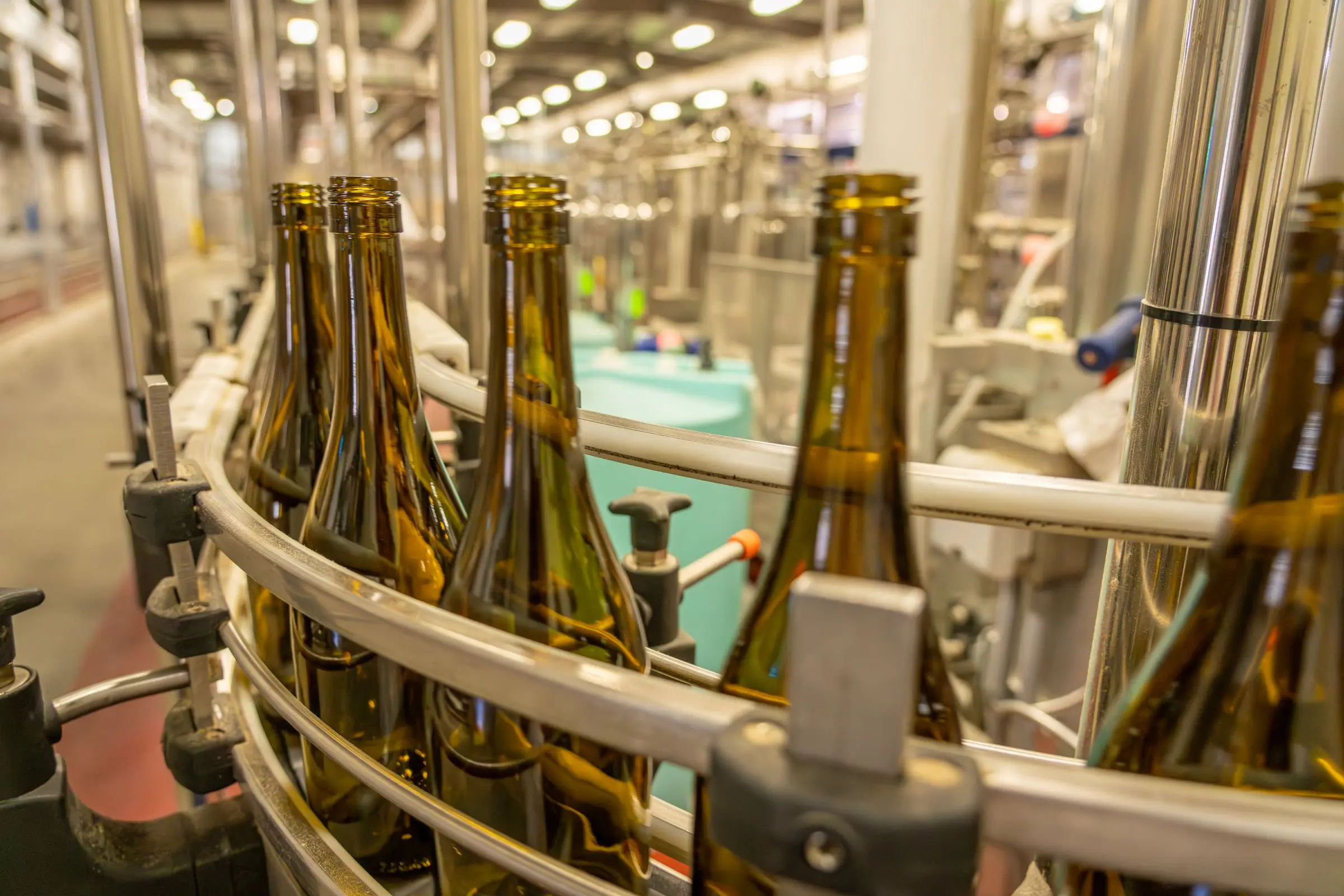
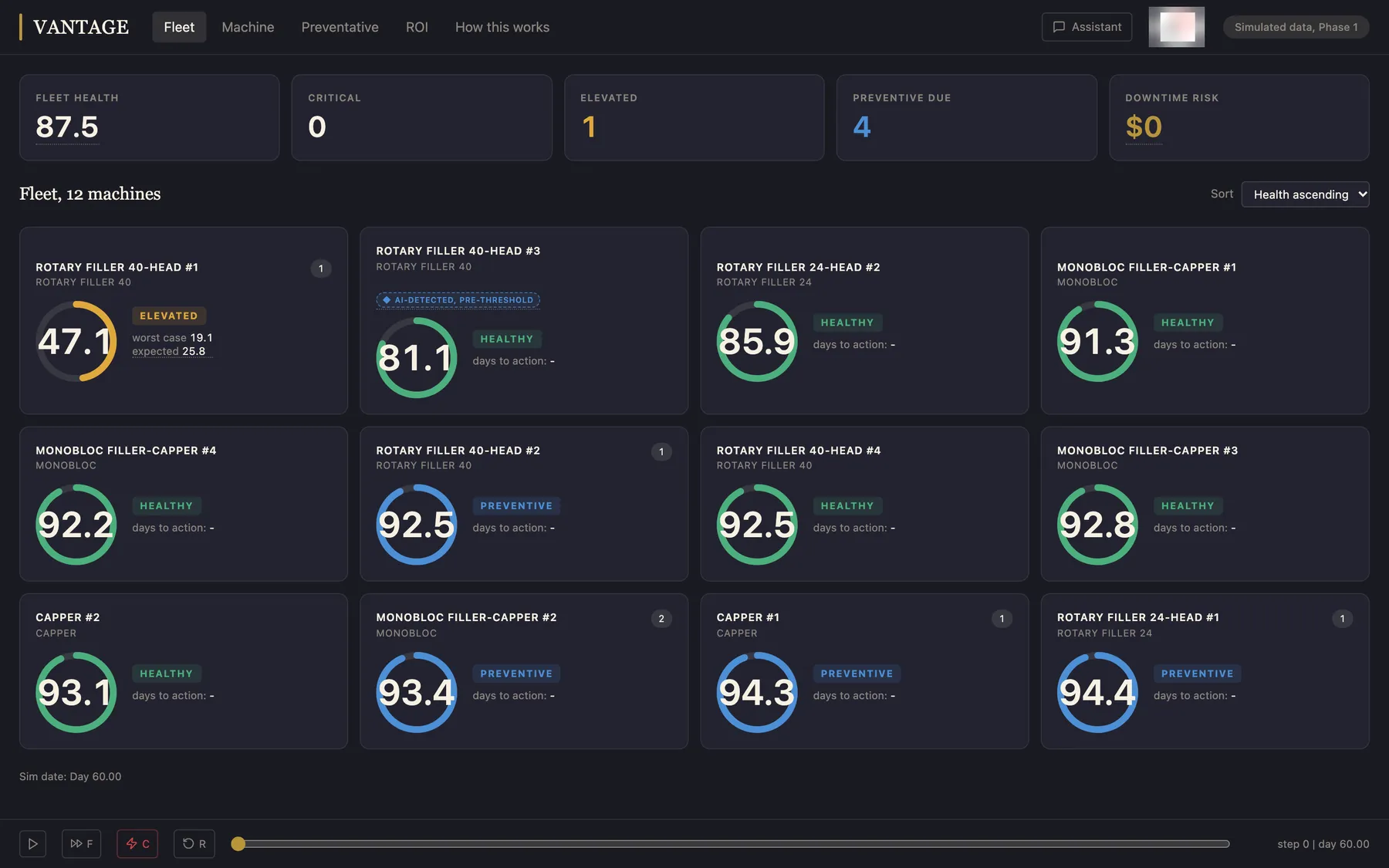
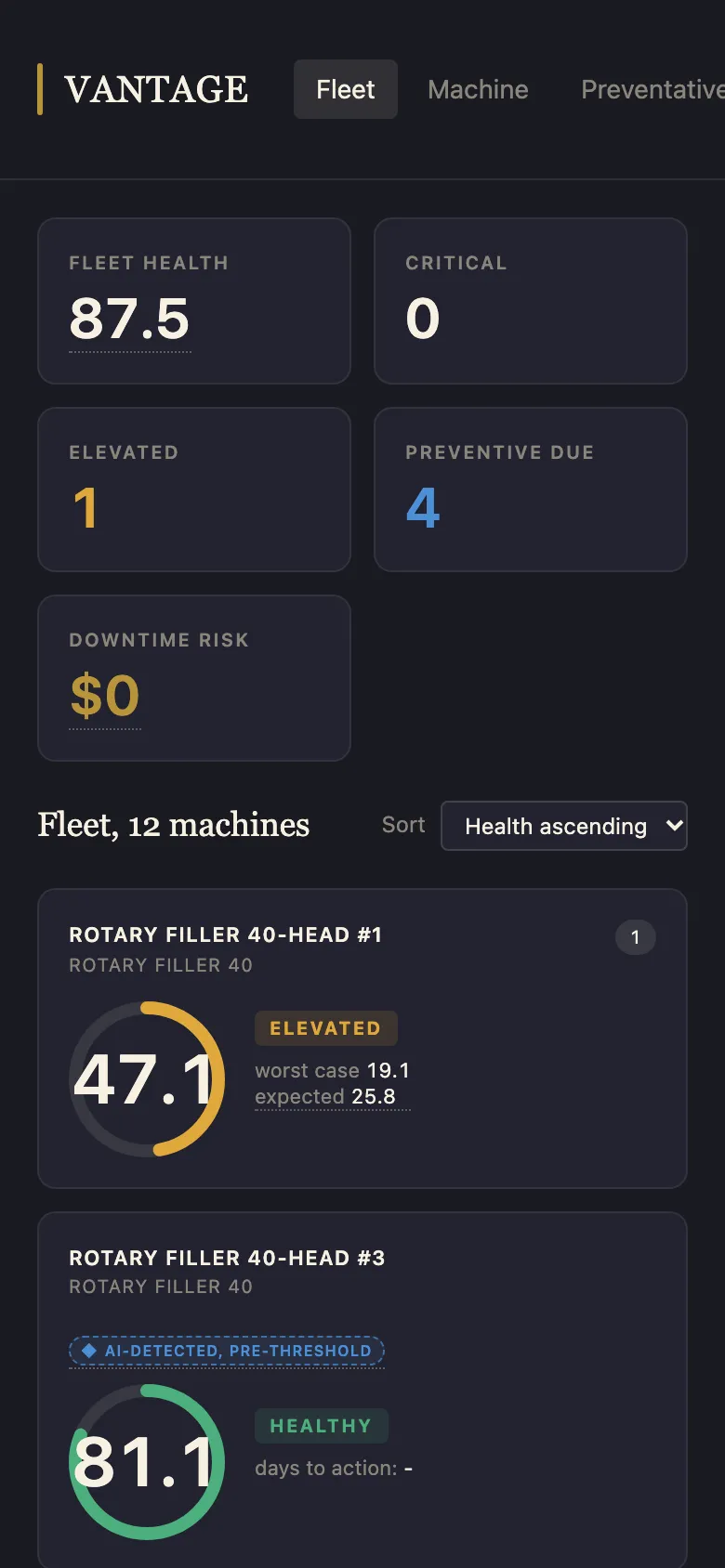
A rotary filler builder has about 250 machines running in customer plants, and a repair after a failure can run into six figures. We added heat, pressure and temperature sensors, plus a camera where visual wear tells more than a probe, and built models that predict wear on specific parts. Each model was tested against faults introduced on purpose before anyone relied on it. Twelve machines are on the platform today, and the builder can extend it across the rest of the fleet.
Read the full storyHow an engagement works
Map the line
Discovery works through the line with production and service, listing which assets fail, what each failure costs and which tags and logs already exist.
Instrument one machine family
A fixed-scope, fixed-price phase adds the missing sensors and connects controllers and historians for one model or one line.
Prove the models on known faults
Models must catch faults we create deliberately before maintenance planners or customers see a single alert.
Extend across the fleet and run it
Once proven, the same pipeline rolls to more machines and plants, and we monitor, retrain and maintain it after launch.
Frequently asked questions
Do we need new sensors before starting?
Not always. Many machines already log motor current, temperatures and cycle counts in the controller, which is enough to begin. We add sensors only where the existing signals cannot see the failure mode, and a camera where wear is visible before it is measurable.
Can a machine builder sell monitoring as a service?
Yes, and many builders should. Once the fleet reports its own health, monitoring becomes a subscription or part of a service contract, and spare parts sales follow the predictions instead of the breakdowns.
Will this work with our existing maintenance system?
Yes. Predictions can open work orders directly in the CMMS you already use, so planners see them in their normal queue. We build to its interfaces rather than asking anyone to change tools.
How do you keep customer plant data separate?
Each customer's machines report into a separate, access-controlled space, and the builder sees only what the service agreement allows. Data stays in the region agreed in writing.
Is a dashboard enough, or do we need models?
A dashboard is enough when the problem is that nobody sees the numbers. Models earn their cost when the numbers are visible but failures still arrive without warning.
What does an engagement cost?
It depends on the number of machines, signals and systems involved. Each phase has a fixed scope and a fixed price agreed before work starts, and our pricing page explains how phases are structured.
Related
- ServicePredictive maintenanceVantage Systems builds predictive maintenance AI (artificial intelligence) that names the part about to fail and the window to fix it, from sensors, controller data and wear models.
- ServiceQuality inspectionVantage Systems builds AI quality inspection: cameras that check every unit and models that flag a drifting station before a batch turns into scrap or rework.
- InsightPredictive maintenance for OEMs (original equipment manufacturer): turning service into a productHow machine builders turn predictive maintenance into a paid service: what to sense, part-level models, testing against induced faults and data rights to sign.
- WorkUnited StatesSensors and models that name the failing part before the line stops.
- IndustryEnergy, oil and gasFailure prediction for pumps and compressors from historian and control data, plus field dashboards and tender agents for energy operators and service firms.
- ServiceOperational dashboardsVantage Systems builds custom business dashboards on live pipelines from your ERP (enterprise resource planning), field and finance systems, with one definition per number. See how they work.
Built for operators with real scale. Most engagements are scoped in the tens of thousands of dollars and up.
Start a conversation.
Tell me what's slowing your operation down. I read every message myself and reply within one business day.