Custom agents for tenders and proposals
AI RFP analysis and tender review for government contractors
Vantage Systems builds artificial intelligence (AI) agents for request for proposal (RFP) analysis that read every file in a government tender package, in English or Arabic, and list exactly what a compliant bid requires. The agent returns a quick check by default and a full brief on demand, so your bid team makes the bid or no-bid call on facts instead of a skim.

What does AI tender analysis actually produce?
A requirements list your proposal manager can work from, not a summary. The agent opens the main solicitation, every annex, the bill of quantities, the drawings register and each addendum, then builds a compliance matrix: every instruction and evaluation criterion, the page and clause it came from, and where your response will answer it. Mandatory documents, deadlines, guarantees and site visit dates get their own list, since missing one can disqualify a bid.
Every line cites its source. The method is covered in our article on AI RFP and tender analysis.
How does it handle Etimad tenders in Saudi Arabia?
It works on the package your team downloads after buying the tender documents on Etimad, the government procurement platform run under Saudi Arabia's Ministry of Finance. Those packages are often mostly Arabic with English technical annexes, and the agent reads both and writes its brief in whichever language your team prefers. It checks the conditions booklet for every certificate and guarantee the government entity asks for and lists each one with the page that requires it.
The agent does not log in to Etimad or submit anything on your behalf; it sits behind your bid team, not in front of the portal. Our Saudi Arabia page explains how we work with Saudi operators.
Does it work for United States public sector RFPs?
Yes. Most negotiated federal solicitations use the Uniform Contract Format, so the agent maps the Section L instructions and Section M evaluation factors against the statement of work and builds the cross-reference proposal managers usually assemble by hand. State, county and city solicitations vary more in layout, so there the agent reads for obligations rather than relying on section numbers. Required forms, page limits and formatting rules land on the checklist too.
What we build for bid teams
Package reader
Takes in every file, including scanned pages through optical character recognition (OCR), pricing spreadsheets and drawings lists, and keeps each requirement tied to its source page.
Compliance matrix
Instructions, evaluation criteria and mandatory submissions in a structured matrix, exported to the spreadsheet or proposal tool your team already uses.
Bid or no-bid brief
Scope, deadlines, qualification thresholds, penalties, payment terms and risks on one page, scored against criteria your leadership sets.
Addendum tracker
When clarifications or addenda arrive, the agent shows exactly which requirements changed and which answers need revisiting.
More for this industry and service
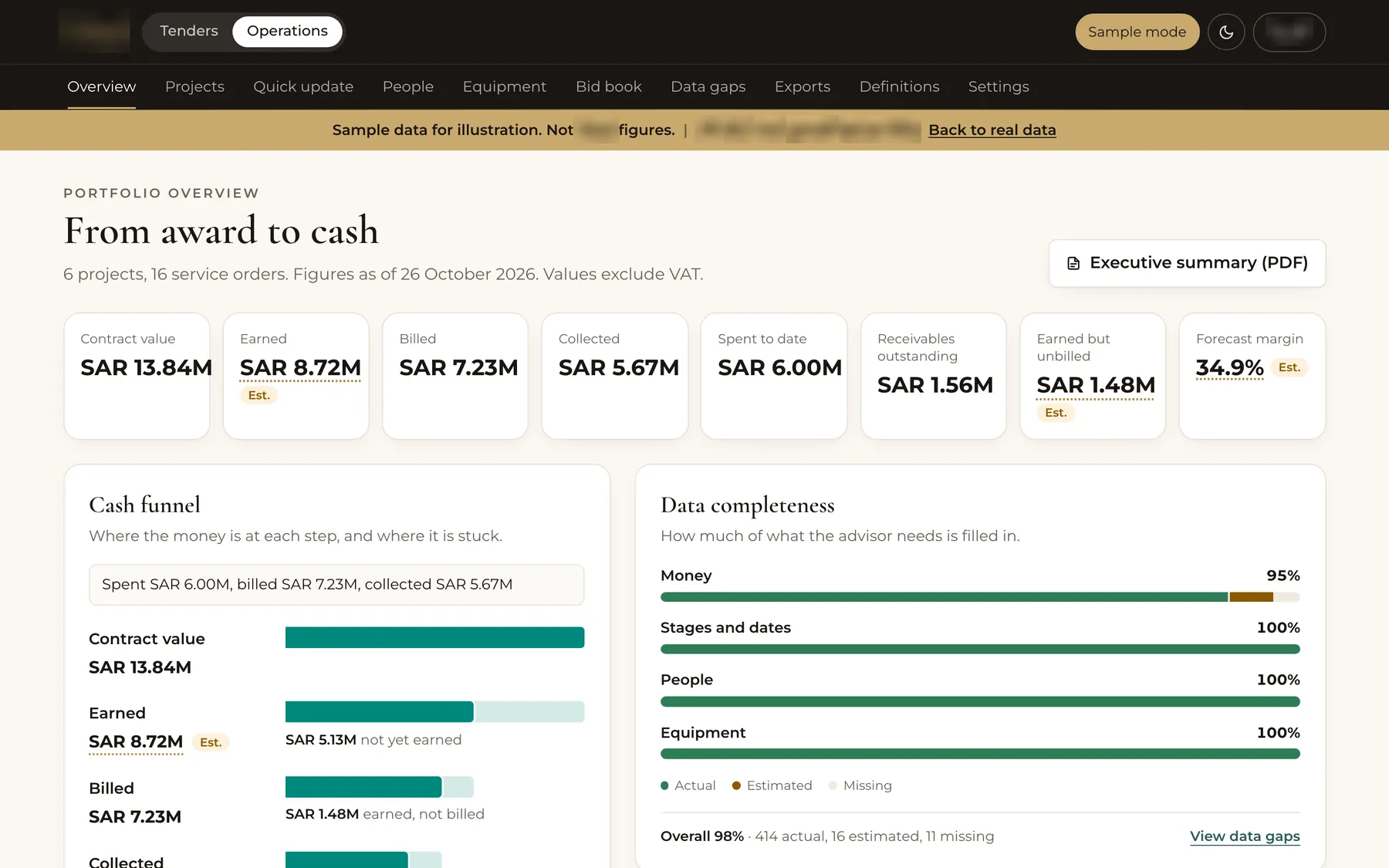
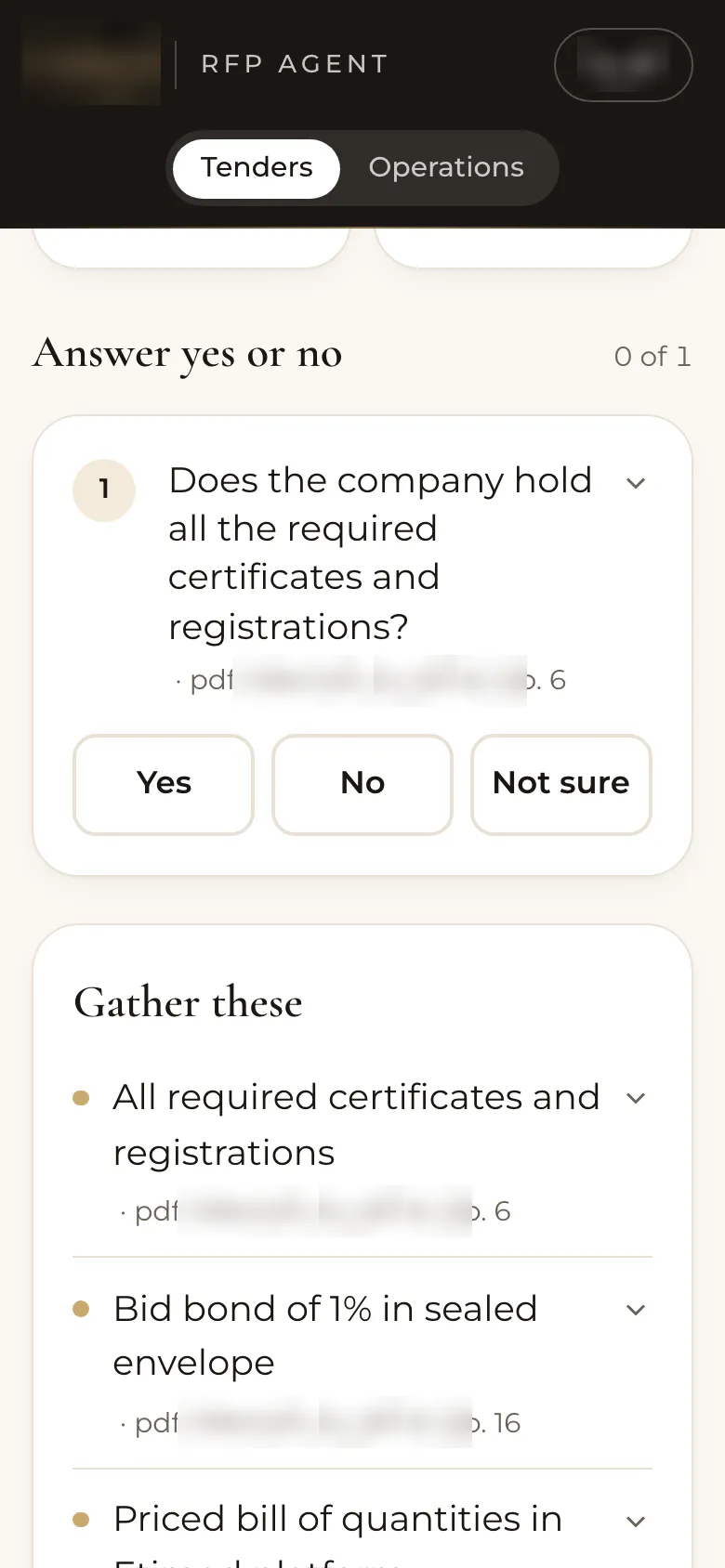
LiveSaudi holding company, Saudi Arabia
A tender agent in daily use at a Saudi holding company
For a holding company that bids on Saudi government work, we built a tender agent that reads every file in each package and lists what the bid needs. It runs a quick check by default and writes a full brief when the team asks for one. Tender reviews there now start from a clear list of requirements, and the system is live and used by leadership.
Read the full storyHow an engagement works
Collect past packages
We gather recent tenders you won, lost or passed on, along with the decisions your team made, to learn what your reviewers look for.
Build against real files
The agent is built and tested on those packages, and your proposal manager marks every requirement it missed or misread.
Run beside the bid team
New tenders go through the agent and your usual review in parallel until the team trusts the checklist.
Keep it current
We update the agent as procurement rules, templates and your qualification criteria change, and we run it for you.
Frequently asked questions
Who makes the final bid or no-bid call?
Your leadership does. The agent gives your team the facts behind that decision and flags qualification gaps, but it never makes the call. The brief is scored against criteria you supply, such as minimum margin and available capacity.
Can it read Arabic and English documents in the same package?
Yes. Mixed-language packages are normal in the Gulf, and each requirement is reported with a citation to the original page in its original language.
Will it write our proposal?
Not by default. Its job is to make sure nothing required is missed, and drafting response sections is a separate scope we add once the analysis is trusted.
How are confidential tender documents handled?
Packages stay in the region agreed with you, access is limited to your bid team, and no package is ever used to train an AI model.
What about scanned or poor quality files?
Scanned pages are read with character recognition, and any page the agent cannot read with confidence is listed for a person to check. It never silently skips a file.
Is this a product we license?
No. It is one of our custom AI agents, built around your packages and review process, owned by you and maintained by us. Contractors we work with are described on our government contractors page.
Related
- ServiceCustom agentsVantage Systems builds custom AI (artificial intelligence) agents that read tenders, claims, loan files and leases, check them against your rules and post results into your systems.
- IndustryGovernment contractors in the GulfTender agents that read Etimad packages in Arabic and English, plus project and billing dashboards, for Saudi and Gulf contractors and holding companies.
- InsightHow to use AI to analyze RFPs (request for proposal) and government tendersUse AI to read every tender file, build the compliance matrix, list mandatory documents and speed up bid or no-bid on Etimad and federal bids with human review.
- WorkSaudi ArabiaReads every tender file and runs the department from one live view.
- Custom agentsFor lendersAI loan document processing that reads statements, pay stubs, returns and appraisals, matches them to open conditions and syncs to your loan origination system.
- PricingHow we priceFixed scope and a fixed price for each phase, and what drives the cost of a build.
Built for operators with real scale. Most engagements are scoped in the tens of thousands of dollars and up.
Start a conversation.
Tell me what's slowing your operation down. I read every message myself and reply within one business day.